What if those stubborn green patches in your yard aren't just intruders, but a diagnostic report on your soil's health? You've likely spent time and money trying to maintain a perfect lawn, only to see ugly patches ruin your curb appeal. It's frustrating to feel like you're losing the battle against an enemy you can't name. You want a clean, meticulous yard without the stress of accidentally killing your good grass.
This guide simplifies weed identification for homeowners across Georgia and Alabama. It's designed to give you professional results and the freedom to enjoy your weekends again. You'll learn to spot the difference between a temporary seasonal nuisance and a serious perennial threat. We even include updates on Alabama's 2026 Year of Invasive Plants initiative to keep your property beautiful and healthy.
We'll provide a clear visual ID for common local weeds and a plan to fix your yard for good. It's time to stop guessing and start seeing the high-end results your home deserves. Let's reclaim your peace of mind and your lawn's visual perfection.
Key Takeaways
- Understand how weeds act as a diagnostic report for your soil, revealing hidden issues like compaction or nitrogen deficiency.
- Master the visual differences between broadleaf intruders and grassy mimics to ensure your removal strategy is precise and effective.
- Use our 2026 weed identification checklist to spot common local invaders like Crabgrass and Henbit in Columbus and Phenix City.
- Follow a proven three-step process involving look, feel, and season. This helps you pinpoint any intruder before it compromises your property's aesthetic.
- Discover why manual weeding and meticulous maintenance provide a cleaner finish than generic sprays. Precision is the key to a premium result.
Why Accurate Weed Identification is the Secret to a Sharp Lawn
A sharp, meticulous lawn is about more than just regular mowing. It requires precision. When you see a green intruder, the first question shouldn't be how to kill it, but why it's there in the first place. Understanding What is a weed? in your specific environment changes your entire approach. It shifts your strategy from reactive spraying to proactive management. Proper weed identification serves as the essential diagnostic phase of high-end property maintenance. It's the difference between a temporary fix and a long-term standard of excellence.
Think of your lawn as a living organism that communicates through its growth. Weeds are the symptoms of underlying health issues. If you ignore the message, the intruder will simply return, regardless of how many chemicals you apply. A weed-free yard starts with knowing exactly what you are fighting. This clarity allows you to treat the root cause, ensuring your grass has the competitive edge it needs to thrive.
Weeds as Soil Indicators
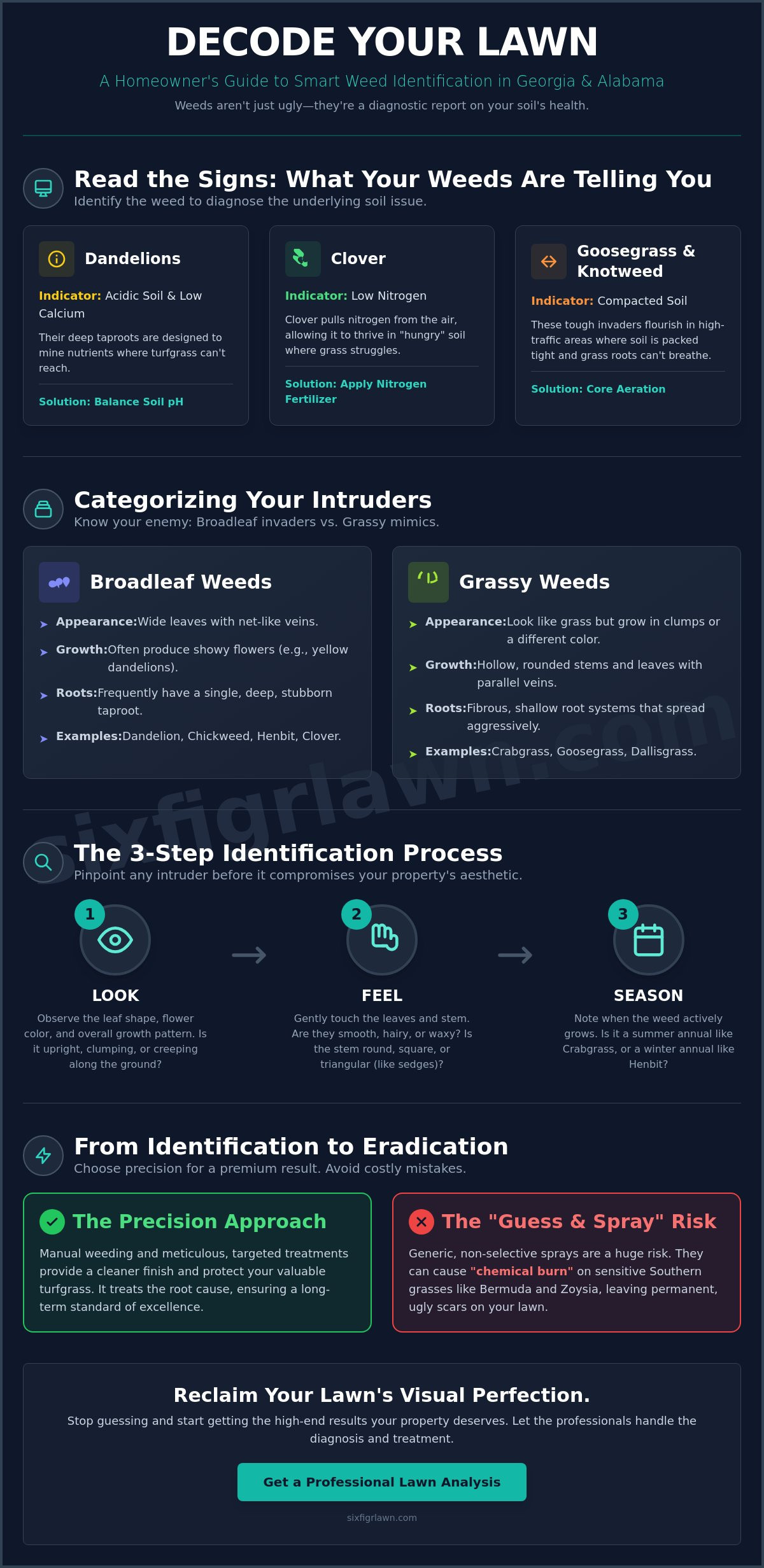
Your lawn is constantly talking to you. Every species of weed thrives in specific conditions, often where your desired turfgrass struggles. By identifying the plant, you identify the soil deficiency. This knowledge is power for any homeowner who values a pristine aesthetic.
- Dandelions: These bright yellow pests often signal acidic soil or a significant lack of calcium. They have deep taproots designed to find nutrients where grass cannot.
- Clover: Seeing patches of white clover usually means your turf is starving for nitrogen. Clover actually pulls nitrogen from the air, allowing it to flourish in "hungry" soil.
- Compacted Soil: Tough, invasive species like goosegrass or knotweed are playgrounds for high-traffic areas. They thrive where soil is packed tight and grass roots can't breathe.
By reading these signs, you can adjust your care routine. Aerating compacted areas or balancing soil pH does more for your curb appeal than a bottle of herbicide ever could. It turns your maintenance into a strategic victory.
The Cost of Misidentification
Guesswork is expensive and risky. Many homeowners reach for a generic bottle of weed killer and end up with "chemical burn." Southern turfgrass species like Bermuda, Zoysia, or St. Augustine are sensitive to specific active ingredients. Using a non-selective product can leave permanent, ugly scars on your lawn. Precise weed identification ensures you only target the enemy while keeping your "good grass" safe and vibrant.
Knowing the specific life cycle of a weed saves you money and time. You don't want to waste resources spraying a winter annual that's already about to die. Similarly, you don't want to ignore a perennial that's currently establishing deep, woody roots. This level of detail protects your investment in professional lawn maintenance services. It's about working smarter to achieve that meticulous, high-end look. Reclaim your personal time by getting the diagnosis right the first time.
Categorizing Your Intruders: Broadleaf vs. Grassy Weeds
To maintain a high-end property, you need a high-end strategy. Not every green sprout is the same. Grouping your lawn's enemies into categories simplifies the weed identification process. It helps you choose the right tools and timing for a pristine result. Most intruders fall into three main buckets: broadleaf weeds, grassy weeds, and sedges. Knowing the difference is the first step toward a meticulous landscape.
Broadleaf weeds are usually the easiest to spot. They have wide leaves with net-like veins that branch out in different directions. Think of the bright yellow of a Dandelion or the small, white flowers of Chickweed. They often produce showy blooms that disrupt the uniform green of your Southern turf. While they're easy to see, they're often the hardest to pull manually because of their deep, stubborn taproots. If you want to keep your curb appeal high, precision is non-negotiable.
Grassy weeds are the mimics of the plant world. They look like your lawn grass at first glance. However, they grow in awkward clumps or show up in a lighter, distracting shade of lime green. Crabgrass is the most notorious example in Georgia and Alabama. These weeds have hollow stems and parallel veins in their blades. They don't just look messy; they compete with your grass for water and nutrients, often winning the battle during the hot summer months.
Don't forget about sedges. These are often mistaken for grass but require a different approach. Sedges have solid, triangular stems. If you feel a stem and it has three distinct sides, it's a sedge. They love wet, poorly drained spots and spread rapidly through underground tubers. Understanding these categories helps you decide if you're dealing with a seasonal annual or a perennial that will return every year. If you're tired of the cycle, professional weeding and maintenance can reclaim your weekends and your peace of mind.
Identifying Broadleaf Varieties
Look for flowers, jagged leaf edges, or round, fleshy leaves. Common local examples include Clover, Dollarweed, and Wild Violet. These species thrive in the humid climate of the South. Because they have such distinct shapes, they act as a visual blemish on a well-manicured yard. They often indicate specific soil conditions, like the nitrogen deficiency signaled by Clover. Identifying them early prevents them from taking over your delicate landscape beds.
The Sneaky Nature of Grassy Weeds
Grassy weeds blend in until they grow twice as fast as your lawn. By the time you notice them, they've often already started spreading seeds. Check for those hollow stems and the way the blades attach to the base. In Alabama, species like Torpedo grass are part of the Class C Noxious weed list for a reason. They're aggressive and resilient. Successful weed identification in this category requires a close look at the growth pattern, especially if the weed is bunching up in a way your Bermuda or Zoysia grass shouldn't.
Common Local Suspects in Columbus, GA and Phenix City, AL
Columbus and Phenix City aren't just any Southern towns. Our clay-heavy soil and the intense humidity of the Chattahoochee Valley create a specific environment for intruders. Generic advice won't cut it here. You need localized weed identification to protect your property's visual perfection. This transition zone requires a disciplined eye to spot the difference between a minor nuisance and a serious threat to your lawn's health.
Dallisgrass is a common enemy in our region. It grows in thick, coarse bunches that disrupt a smooth, professional mow. It's resilient and thrives in the heat. In Phenix City, you must also watch for Class C noxious weeds like Torpedo grass and Chamberbitter. These are legally recognized threats to Alabama's landscapes. Then there's Nutsedge. Often called "water grass," its waxy leaves are a clear signal of drainage issues. If you see it shooting up faster than your Bermuda grass, you've got a moisture problem. These intruders don't just look bad. They compete for resources and win if you don't act decisively.
The Crabgrass Challenge
Crabgrass is the ultimate summer nightmare. It waits for the intense Columbus heat to stress your lawn, then it strikes. You'll recognize it by its low-growing, sprawling "crab-like" legs that fan out from a central point. It's aggressive. It's messy. It's a direct threat to your curb appeal. It flourishes when your desired grass goes dormant or slows down. To keep your property looking meticulous, you need a proactive plan. Learn more in our Crabgrass prevention guide.
Winter Weeds in the Chattahoochee Valley
Don't let your guard down when the temperature drops. Winter weeds are just as disruptive to your landscape's aesthetic. Henbit is a primary culprit. It appears in late winter, dotting lawns with tiny purple flowers. While it might look like a wildflower, it's actually an intruder stealing nutrients from your sleeping turf. Chickweed is another winter regular. It forms dense, lime-green mats in shady, moist areas. Proper weed identification in January and February prevents these from seeding for next year. A clean lawn in spring starts with a disciplined approach in the winter. Reclaim your personal time by stopping the cycle before it begins.
The 3-Step Identification Process: Look, Feel, and Season
Empowerment starts with a simple, disciplined approach. You don't need a botany degree to protect your curb appeal. You just need a system. This 3-step process turns weed identification into a fast, reliable routine. By using your eyes, your hands, and the calendar, you can pinpoint the intruder before it spreads. This precision ensures your property remains a standard of visual perfection without wasting your personal time on guesswork.
Start with a visual inspection. Check the leaf shape, color, and growth pattern. Is it a single plant or a creeping mat? Does it have a distinct flower? Next, move to the tactical feel. This is where many homeowners miss the mark. Finally, consider the seasonal context. A plant appearing in the February frost is a different beast than one emerging in the July heat. These clues work together to reveal the culprit's identity and its specific weakness.
Visual and Physical Clues
Get close to the ground. A meticulous yard requires attention to detail. Look at the root system. A single, deep taproot usually indicates a perennial broadleaf like a dandelion. A fibrous, shallow mat is common in annual grasses. Check for unique textures. Does the leaf feel fuzzy? Does the stem leak a milky sap when broken? These are telltale signs of specific invasive species. One of the most important physical checks is the stem shape. Is it round, square, or triangular? If the stem has three distinct sides, you're almost certainly dealing with a Sedge. This physical certainty allows for a sharp, effective solution. If the manual labor feels like too much, you can always book professional weeding to restore your lawn's cleanliness.
Timing Your ID Efforts
Nature follows a strict schedule. Understanding the "when" is just as vital as the "what" for successful weed identification. In Georgia and Alabama, our seasons dictate the intruder's life cycle. Spring weeds are typically annuals. They grow fast and drop seeds even faster. Your goal is to spot them before they finish their cycle and ruin next year's lawn. Summer weeds are different. They are built for drought resistance and high temperatures. They strike when your turfgrass is most vulnerable to heat stress. Fall is perhaps the most critical time for identification. Spotting the early signs of winter intruders allows for the precise application of pre-emergent treatments. This proactive mindset keeps your property beautiful year-round, ensuring a high-quality result with zero friction.
From Identification to Eradication: Reclaiming Your Property
Once you've completed the 3-step process of weed identification, the focus shifts to decisive action. A high-end property doesn't just happen. It's the result of disciplined, consistent maintenance. You now know exactly what you're fighting. The question is how you reclaim your lawn's visual perfection without sacrificing your personal time. While many turn to generic chemical sprays, a truly meticulous landscape often requires a more refined, professional touch. It's about maintaining a standard of excellence that reflects your pride in your home.
Precision is vital for a premium look. Non-selective herbicides can easily drift, leaving unsightly brown spots on your prize-winning Zoysia or Bermuda grass. This is why many homeowners are rediscovering the hand weeding benefits that come with manual removal. It's about protecting your delicate landscape beds and ensuring that only the intruders are removed. This surgical approach eliminates the risk of accidentally killing the good grass and maintains the visual integrity of your yard.
Beyond manual removal, your regular maintenance routine acts as a natural barrier. Professional mowing at the correct height and frequency is a powerful, chemical-free tool. It keeps your turf thick and resilient. A dense canopy chokes out the sunlight that weed seeds need to germinate in the Georgia and Alabama soil. When combined with precision edging, you create a sharp, clean boundary that weeds struggle to cross. If the task seems overwhelming or your property has been neglected, it's time for strategic weeding services.
The Professional Advantage
Sixfigr Lawn Care understands that your time is your most valuable asset. We take pride in our craft so you don't have to spend your weekends in the dirt. Our approach focuses on several key factors:
- Precision edging: We stop weeds from creeping in from the sidewalk or driveway.
- Thick turf maintenance: We keep your grass healthy enough to crowd out intruders naturally.
- Meticulous results: Sixfigr Lawn Care handles the labor, ensuring your property remains a standard of excellence.
We handle the details while you enjoy the visual perfection of a clean, weed-free yard. It's about freedom and peace of mind. Reclaim your personal time while we handle the meticulous work of keeping your landscape pristine.
Your Next Steps for a Clean Lawn
Start by documenting your findings. Take a clear photo of the intruder for your lawn technician. This makes weed identification even more accurate during your next service visit. Avoid mowing over weeds that have already gone to seed. Doing so simply spreads the problem across your entire property, making the next growth cycle even harder to manage. When you're ready for a total transformation and a yard that reflects your high standards, Request a quote for a comprehensive cleanup today. Let's get your lawn back to its high-performing best.
Enjoy a Meticulous Lawn Without the Effort
Your property is a reflection of your high standards. Now that you've mastered weed identification, you can stop guessing and start seeing visual perfection. You've learned to read your soil's health and spot the specific intruders common in Columbus and Phenix City. A sharp, clean landscape is no longer a mystery; it's a manageable goal.
Achieving a premium aesthetic shouldn't come at the cost of your personal time or peace of mind. Sixfigr Lawn Care specializes in professional precision and reliable, neighborly service. From expert hand-weeding to meticulous edging and mowing, our team handles the heavy lifting with disciplined care. We value your time as much as you do. We take pride in delivering results that allow you to truly enjoy your outdoor space.
It's time to end the cycle of ugly patches and wasted weekends. Reclaim your time and your lawn. Get a Sixfigr Lawn Care quote today. Let's build a healthier, more beautiful yard together. Your property is in expert hands.
Frequently Asked Questions
How can I tell the difference between a weed and my grass?
You can distinguish a weed from your turf by observing its growth pattern and color. Weeds usually grow much faster than Bermuda or Zoysia grass and often appear in a distracting shade of lime green or yellow. If a plant forms a dense bunch or a sprawling mat that disrupts the uniform texture of your yard, it's an intruder.
What is the most common weed in Columbus, GA?
Crabgrass is the most persistent summer nuisance in Columbus, GA. This aggressive annual thrives in the intense heat and clay-heavy soil of the region. In the winter, you'll see a surge in Henbit and Chickweed across the Chattahoochee Valley, turning dormant brown lawns into patchy purple or green eyesores.
Is it better to pull weeds or spray them?
Manual weeding is the superior choice for a meticulous, high-end look. It avoids the risk of "chemical burn" on your desired grass and provides immediate results. While spraying is faster for large areas, hand-pulling ensures total removal of the root system without harming the visual perfection of your landscape beds.
Why do I have so many weeds in my yard all of a sudden?
A sudden explosion of weeds often indicates your turfgrass is under stress from heat, drought, or soil compaction. When your grass thins out, it leaves space for opportunistic seeds to germinate. It's a signal that your lawn's natural defenses are down and your maintenance routine needs more precision.
Can weeds actually damage my lawn permanently?
Aggressive invasive species can cause lasting harm by completely choking out your healthy grass. Weeds like Torpedo grass spread through underground rhizomes that are incredibly difficult to eradicate once established. Early weed identification is the only way to prevent a total lawn takeover that might require a full renovation.
What does a purple-flowered weed in spring mean?
Seeing purple flowers in early spring usually means you have an infestation of Henbit or Purple Deadnettle. These winter annuals germinate in the fall and bloom as soon as the weather warms. Their presence suggests that your late-year maintenance was missed, allowing seeds to take root while your grass was dormant.
How do I identify a weed that looks like a tiny tree?
If you see a weed resembling a tiny mimosa tree, you're likely looking at Chamberbitter. It's a warm-season broadleaf that grows upright with small, round seeds attached to the underside of its leaves. It thrives in the humid climate of Georgia and Alabama and can spread rapidly if not removed manually.
Does frequent mowing help with weed identification and control?
Frequent mowing is a powerful tool for both control and weed identification. It prevents many species from ever reaching the flowering stage where they drop thousands of seeds. A consistent, professional mow also makes it easier to spot intruders that grow at a different rate than your uniform turf height.